Object Detection: Classical CV vs YOLOv8n
Abstract
Two object-detection pipelines run on the same nine public-domain test images so the strengths and failure modes of each are easy to read off. Pipeline 1 is a classical edge-and-contour pipeline (Gaussian blur, Canny, morphological close, contour bounding boxes). Pipeline 2 is YOLOv8n pretrained on COCO. The classical pipeline locates regions; the deep-learning pipeline classifies them. Each pipeline wins in different regimes, and the comparison makes those regimes explicit.
Pipeline 1 — Classical CV
Gaussian blur (5 × 5)
  → Canny edge detection (50, 150)
  → morphological close (5 × 5 rect kernel)
  → external contour finding
  → bounding box for every contour with area ≥ 500 px²
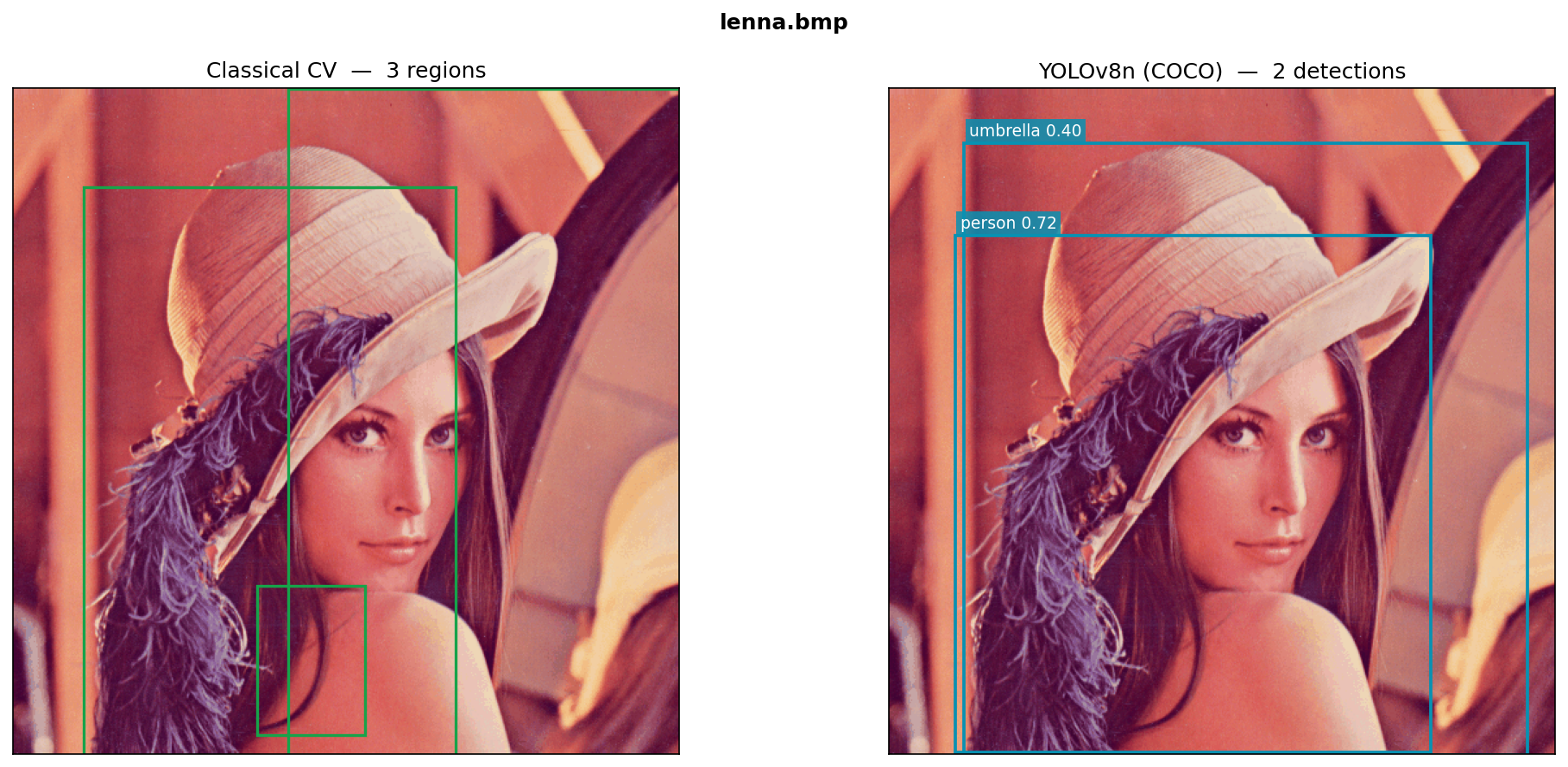
Detections are unlabelled. The pipeline cares about where the boundaries are, not what is bounded.
Pipeline 2 — YOLOv8n on COCO
Inference via the ultralytics package, confidence threshold 0.20. The COCO class set covers 80 categories: people, animals, vehicles, common indoor and outdoor objects. Detections come with class labels and confidence scores. Anything outside the 80-class vocabulary is invisible to the model.
Results Across the Nine Images
| Image | Classical | YOLOv8n | YOLO classes |
|---|---|---|---|
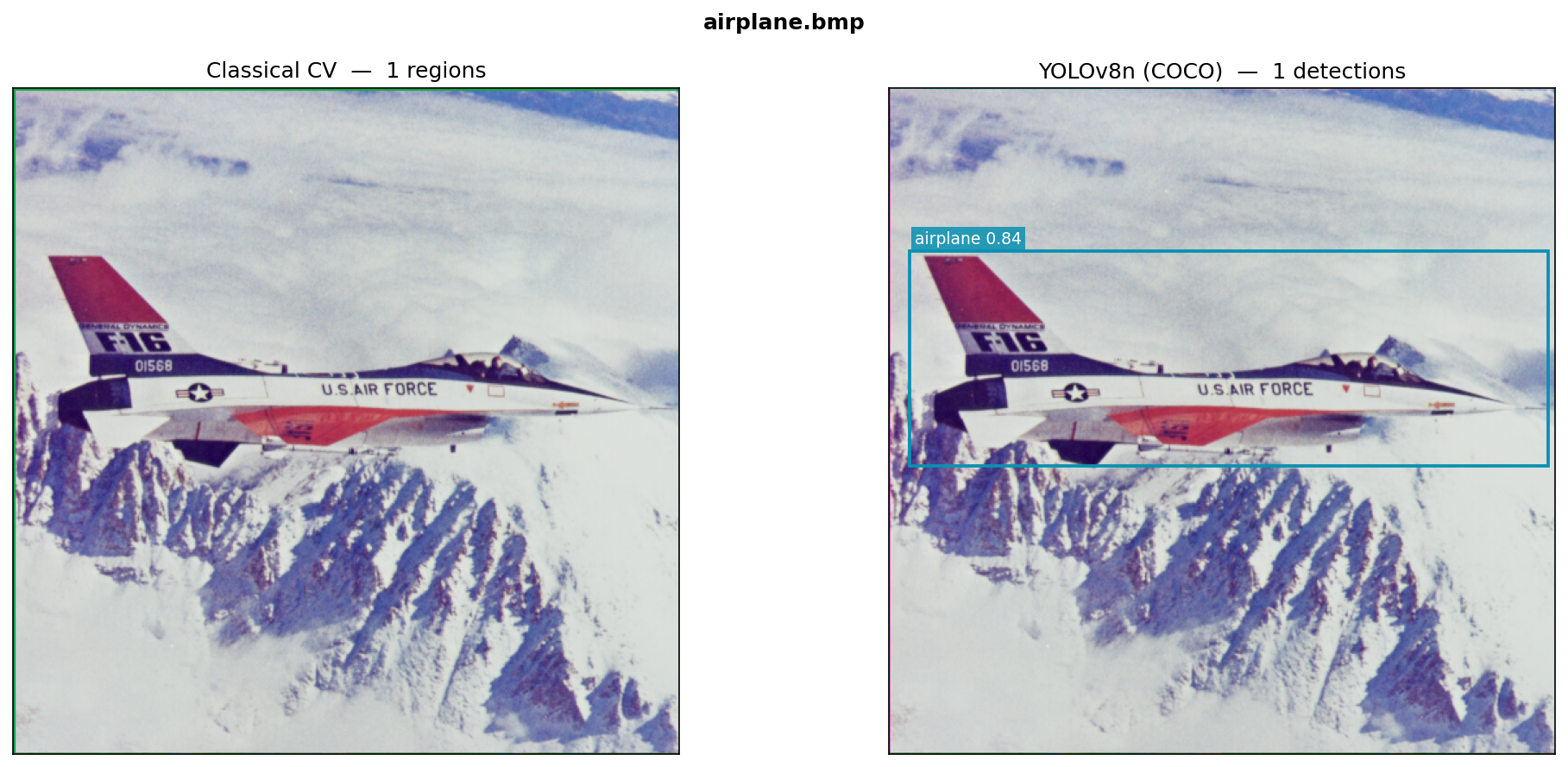
| airplane | 1 | 1 | airplane |
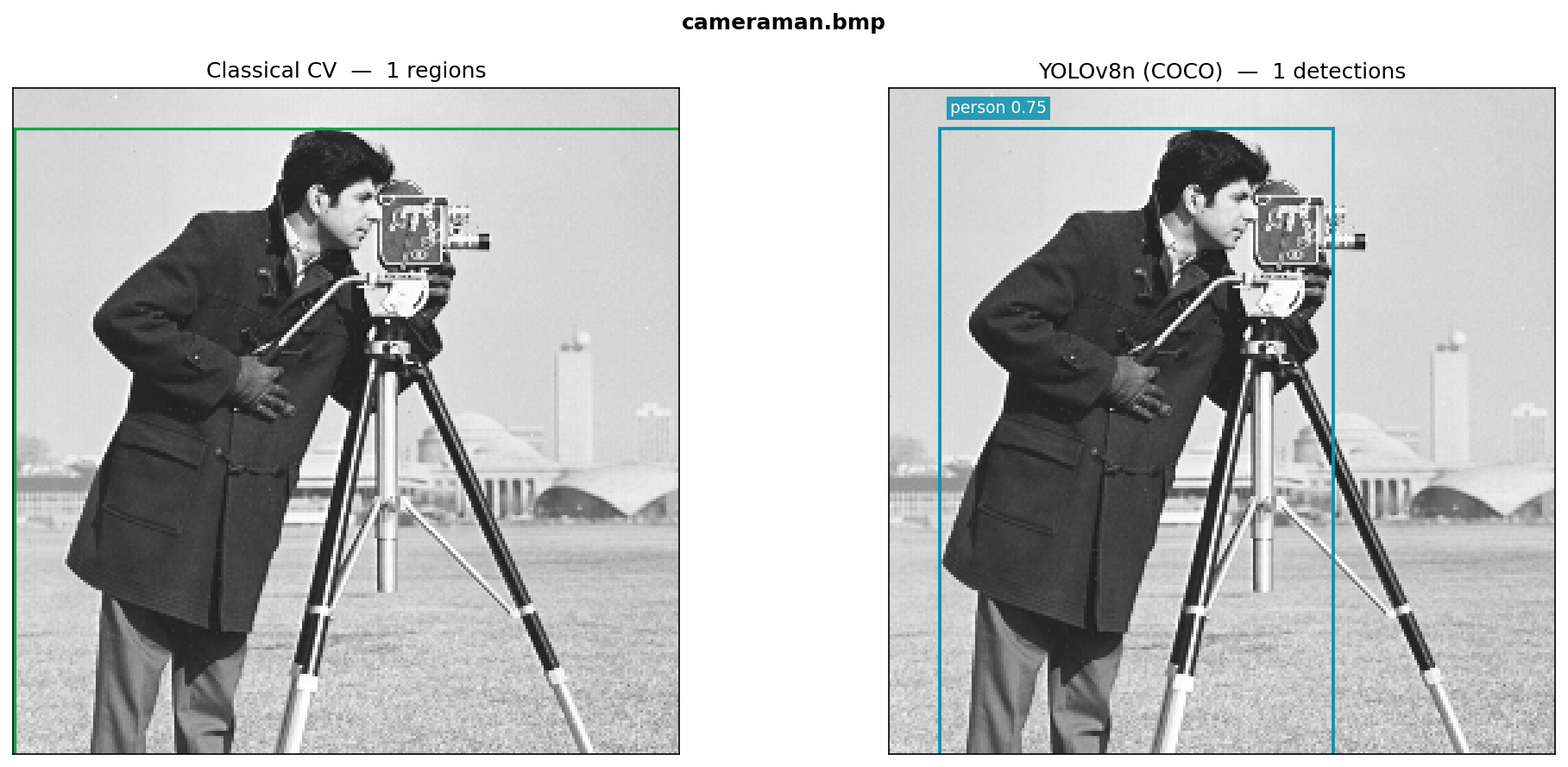
| cameraman | 1 | 1 | person |
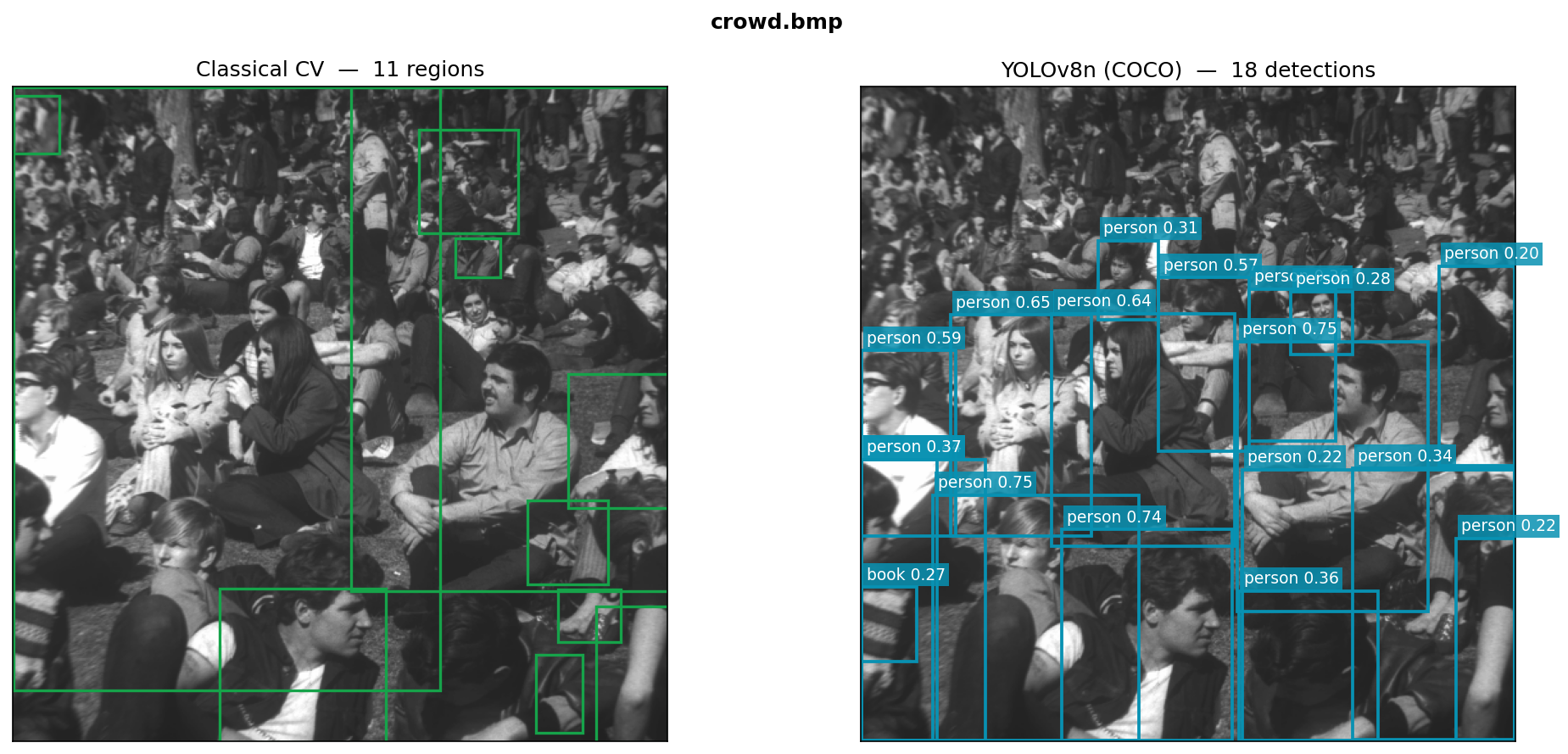
| crowd | 11 | 18 | person, book |
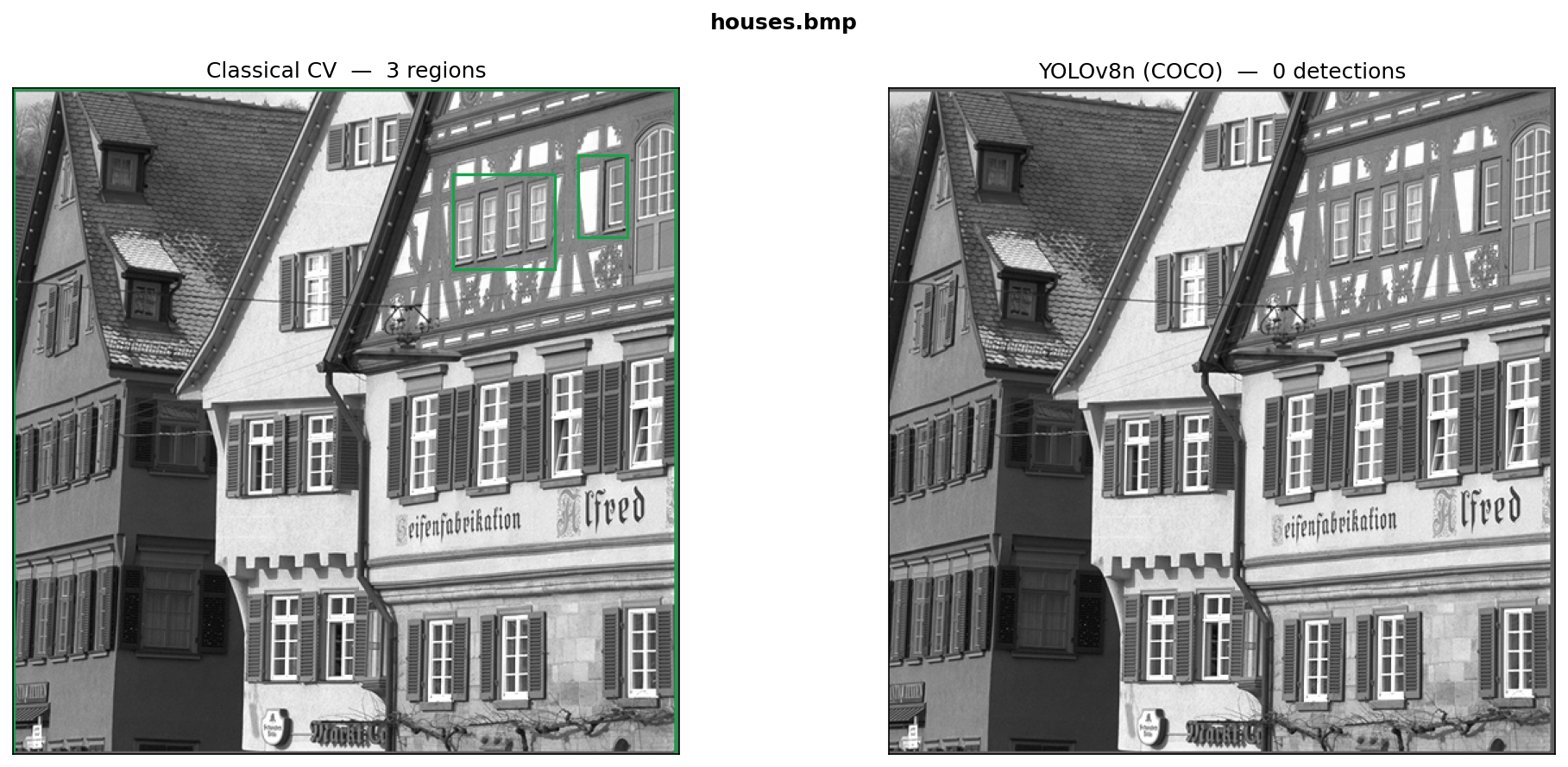
| houses | 3 | 0 | — (no relevant COCO class) |
| lenna | 3 | 2 | person, umbrella |
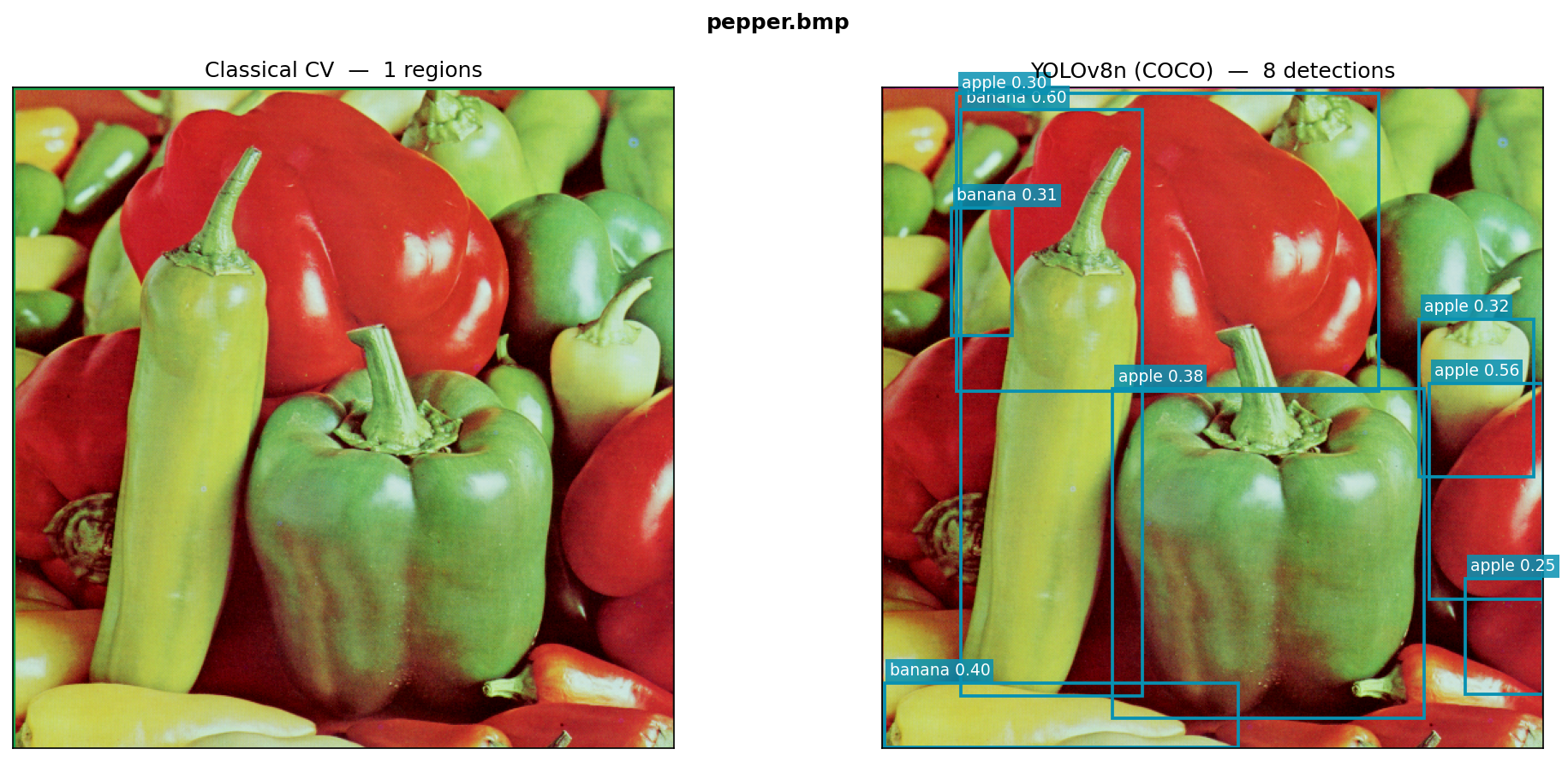
| pepper | 1 | 8 | apple, banana |
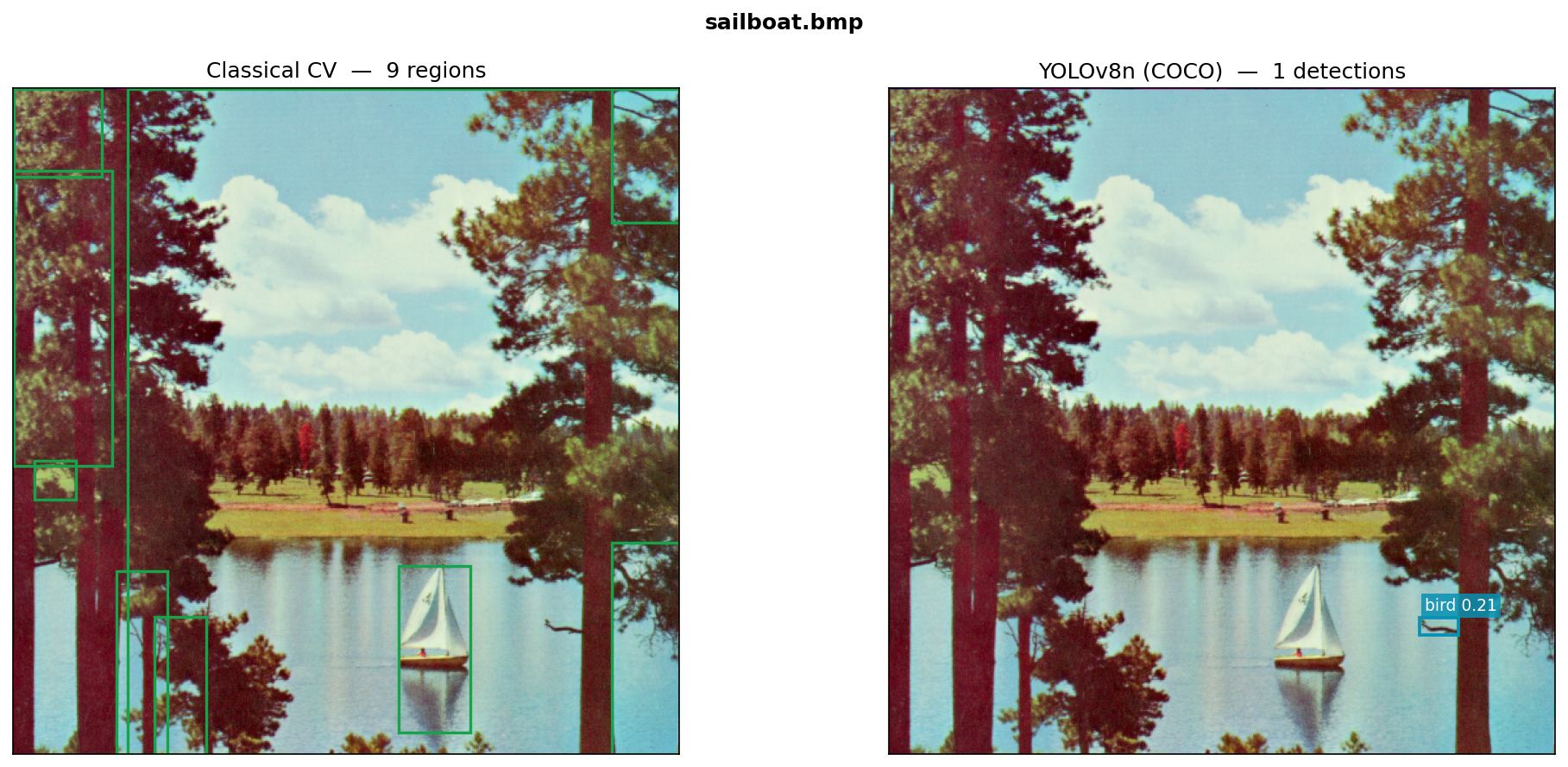
| sailboat | 9 | 1 | bird |
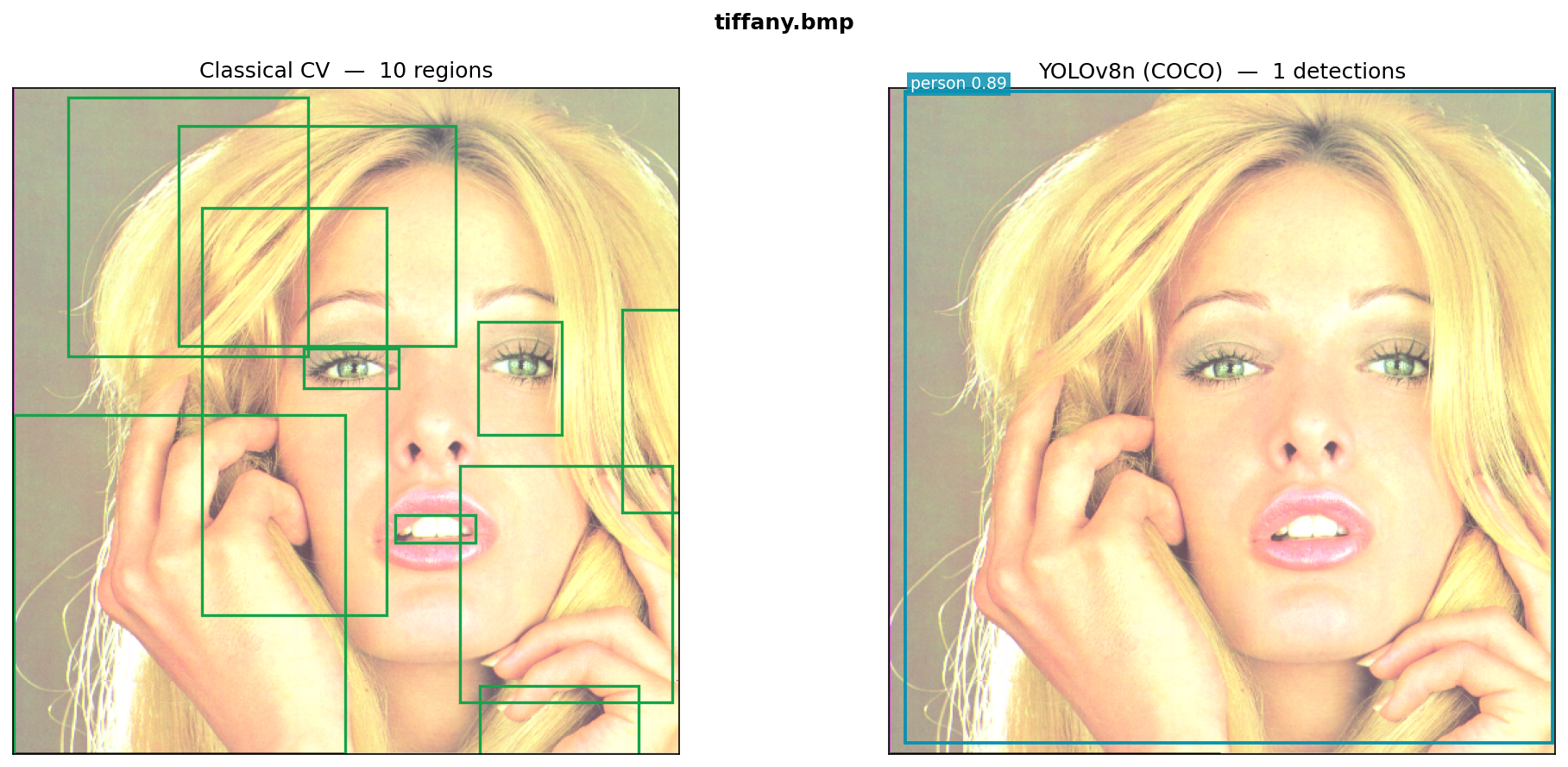
| tiffany | 10 | 1 | person |
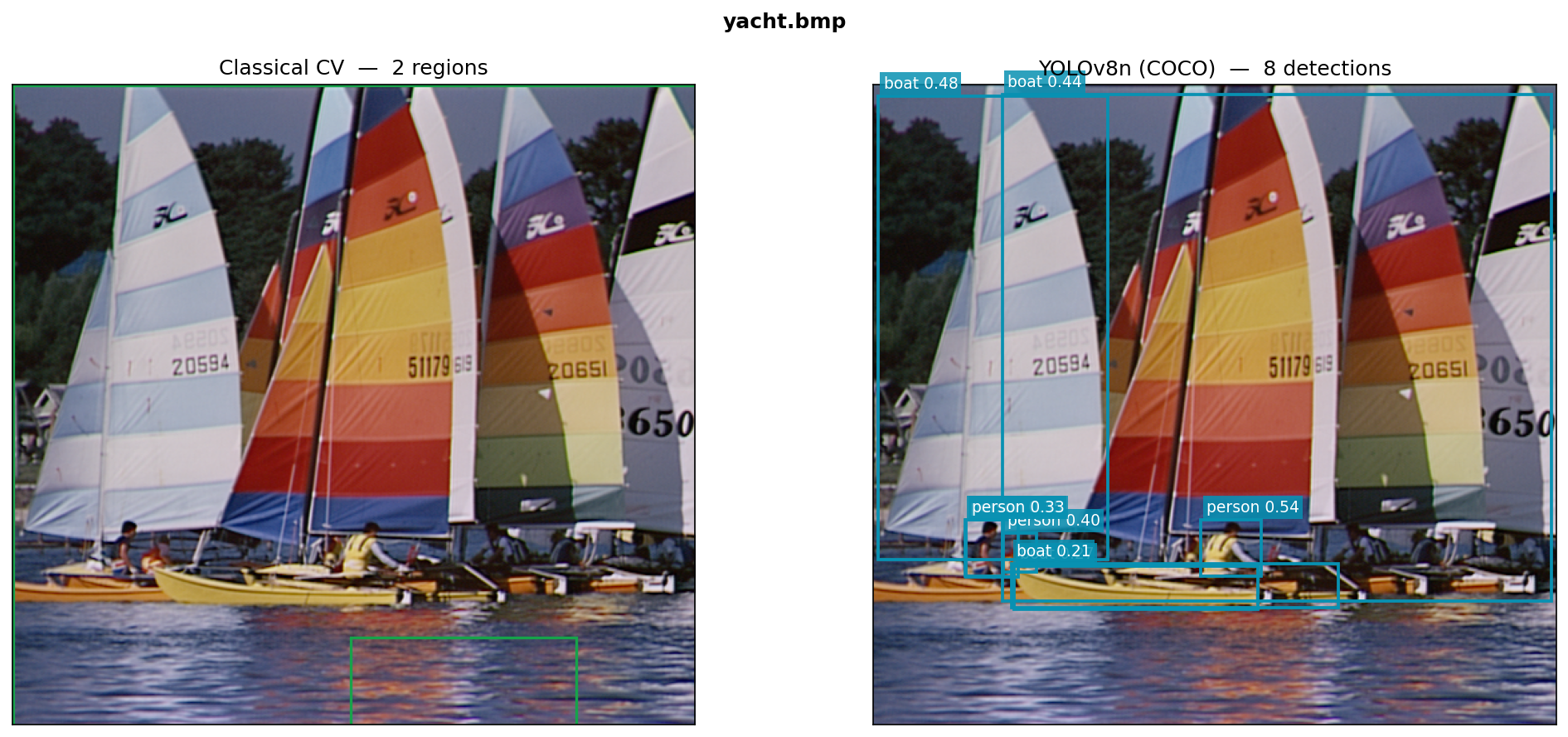
| yacht | 2 | 8 | boat, person |
Where Each Pipeline Wins
- YOLOv8n wins when scenes contain COCO categories with strong prototypical structure. The crowd image (17 people plus a book) and the yacht image (boat plus person) recover semantically meaningful counts the classical pipeline only sees as edge clusters.
- Classical wins when the objects are structural rather than semantic. The houses image returns three rectangular regions; YOLO has no "house" class in the COCO vocabulary and reports zero detections.
- Both miss the same way on the sailboat image: classical over-counts ripples on the water, YOLO mistakes a sail for a bird because the COCO bird examples include white-on-blue silhouettes.
- Pepper is an instructive failure: bell peppers are not in COCO, so YOLO recruits the closest visual prototypes (apple, banana). Classical sees one large blob.
Side-by-Side Comparisons
Summary Across the Set

Detections per image per pipeline (left), and top YOLOv8n classes across the test set (right).