Mechanical Properties of Auxetic Metamaterials
Abstract
Eight-week summer research project at UCLA's LEMUR lab (PI: Prof. Ankur Mehta) on auxetic structures, that is, periodic lattice unit cells whose geometry produces a negative effective Poisson's ratio. The deliverable was a library of laser-cuttable unit cells across the chiral / re-entrant / star-honeycomb families, plus a deployable dome demonstrator built from a tessellated auxetic sheet that opens out from a flat-packed initial state under uniaxial tension. The interesting engineering is the relationship between unit-cell geometry, in-plane Poisson's ratio, and out-of-plane Gaussian curvature in the deployed surface.
Auxetic Behaviour, Briefly
Conventional materials have positive Poisson's ratio: stretch them in x and they shrink in y. Auxetic structures invert that:
ν = −(ε_y / ε_x) ν < 0 for auxetic materials
Stretching an auxetic sheet makes it widen rather than narrow. The key insight is that this behaviour comes entirely from geometry, not material chemistry, so it can be engineered into any base substrate that takes the unit-cell pattern, including paper, polymer film, sheet metal, and bio-compatible polymers. Practical consequences include: indentation hardening (the material flows toward an impact, not away from it), curvature compatibility (a flat auxetic sheet can deploy into a doubly-curved surface without cuts or gores), and damage-tolerant draping over compound shapes.
Unit-Cell Library & Manufacture
A library of unit-cell patterns was prepared as DXF files for laser-cutter and Cricut/Cameo workflow. Each cell is parameterised on aspect ratio, ligament thickness, and rotation angle so the same family can be tuned across a range of effective Poisson ratios.
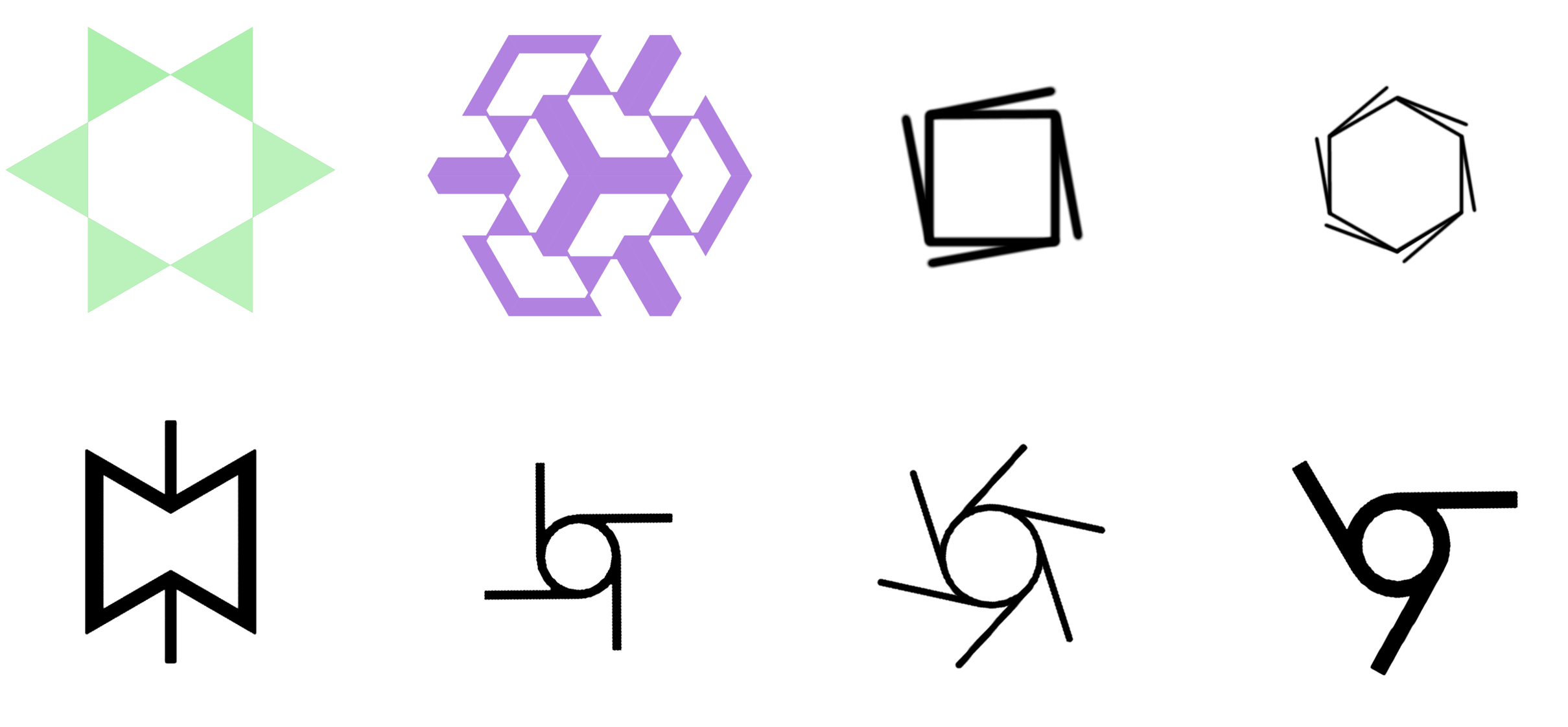
Unit-cell DXF library
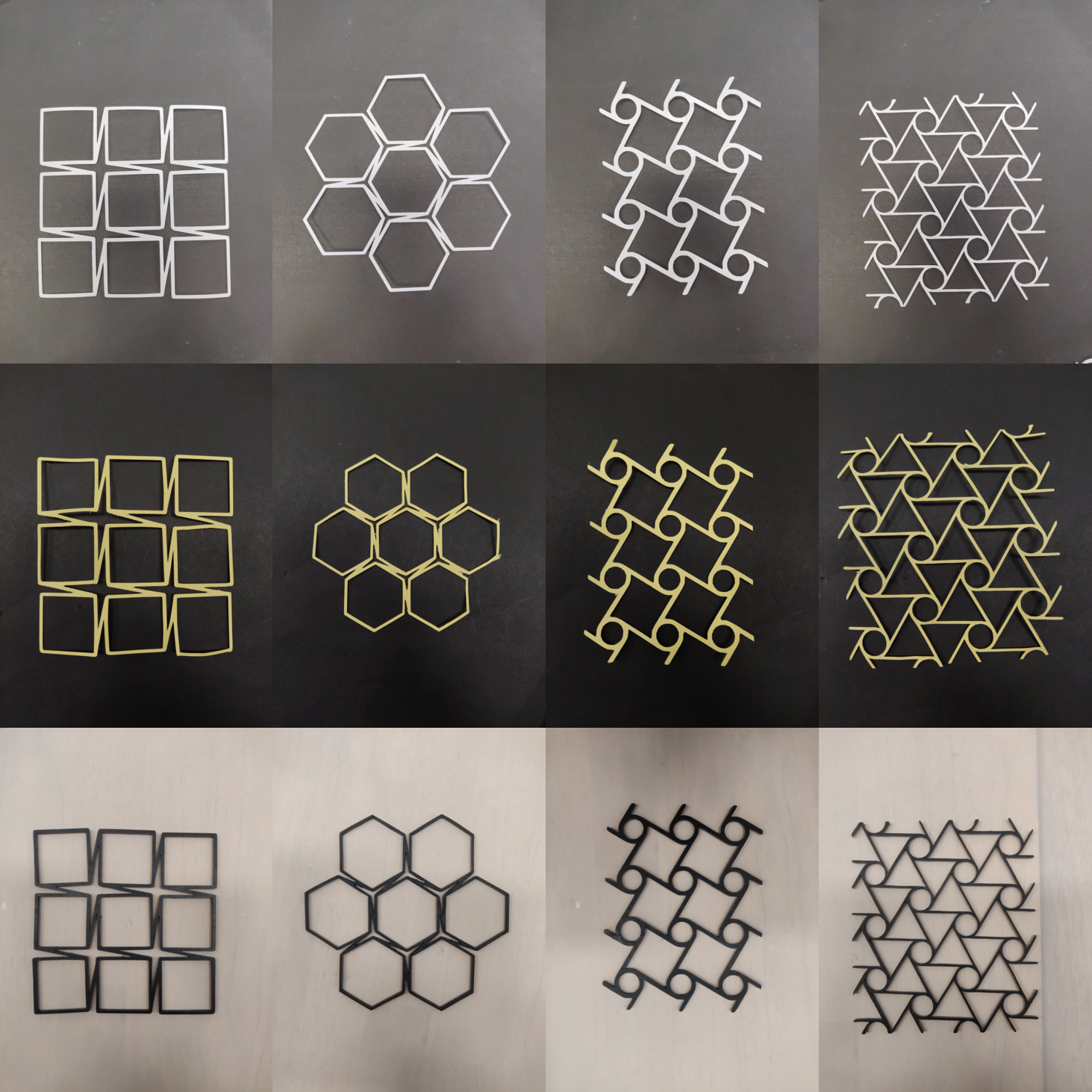
Manufactured samples
Lattice Dynamics
Quasi-static FEM simulation of two of the unit-cell families under uniaxial tension. The hexa-chiral lattice rotates its central nodes as the ligaments are pulled, producing the negative Poisson's ratio without buckling. The square-chiral lattice does the same but at a different effective ratio, controlled by the chiral angle of the ligaments.
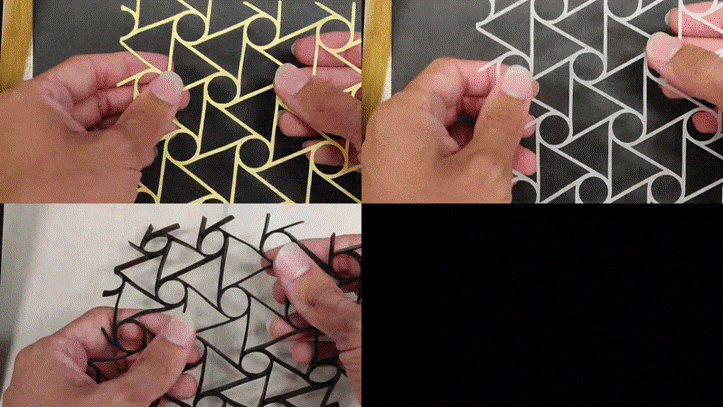
Hexa-chiral lattice under tension
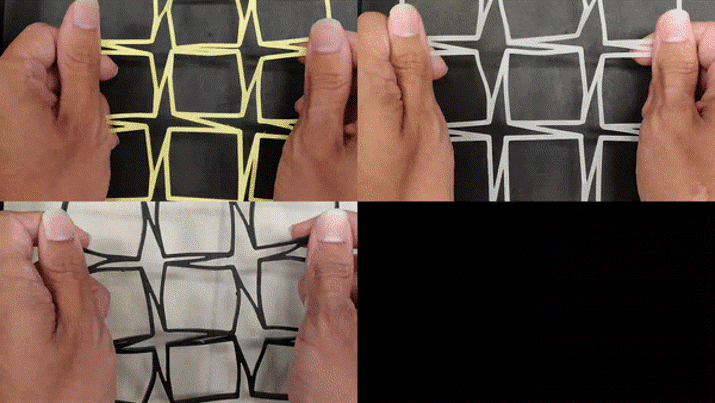
Square-chiral lattice under tension
Deployable Dome Demonstrator
Tiling the chiral unit cell across a flat sheet with a graded ligament length produces a sheet that, when pulled outward, deploys into a hemispherical dome. This is the auxetic-to-Gaussian-curvature trick: a flat sheet with positive ν can only develop zero or negative Gaussian curvature when deployed (cylinders, saddles); a flat sheet with negative ν can develop positive Gaussian curvature (domes, spheres) without tearing or buckling.
Top view
Front view
3-D perspective
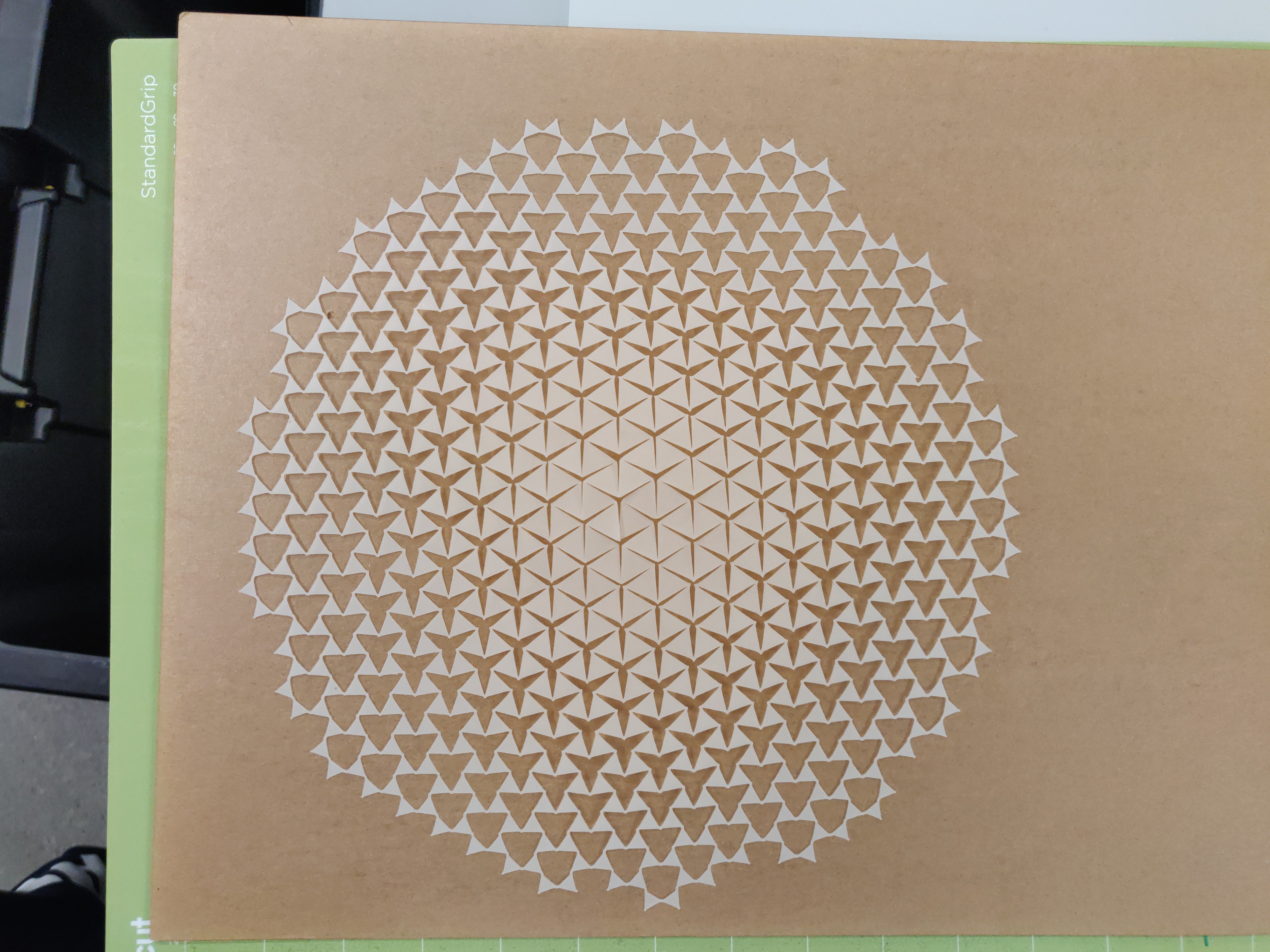
CAD top view (pre-deployment)
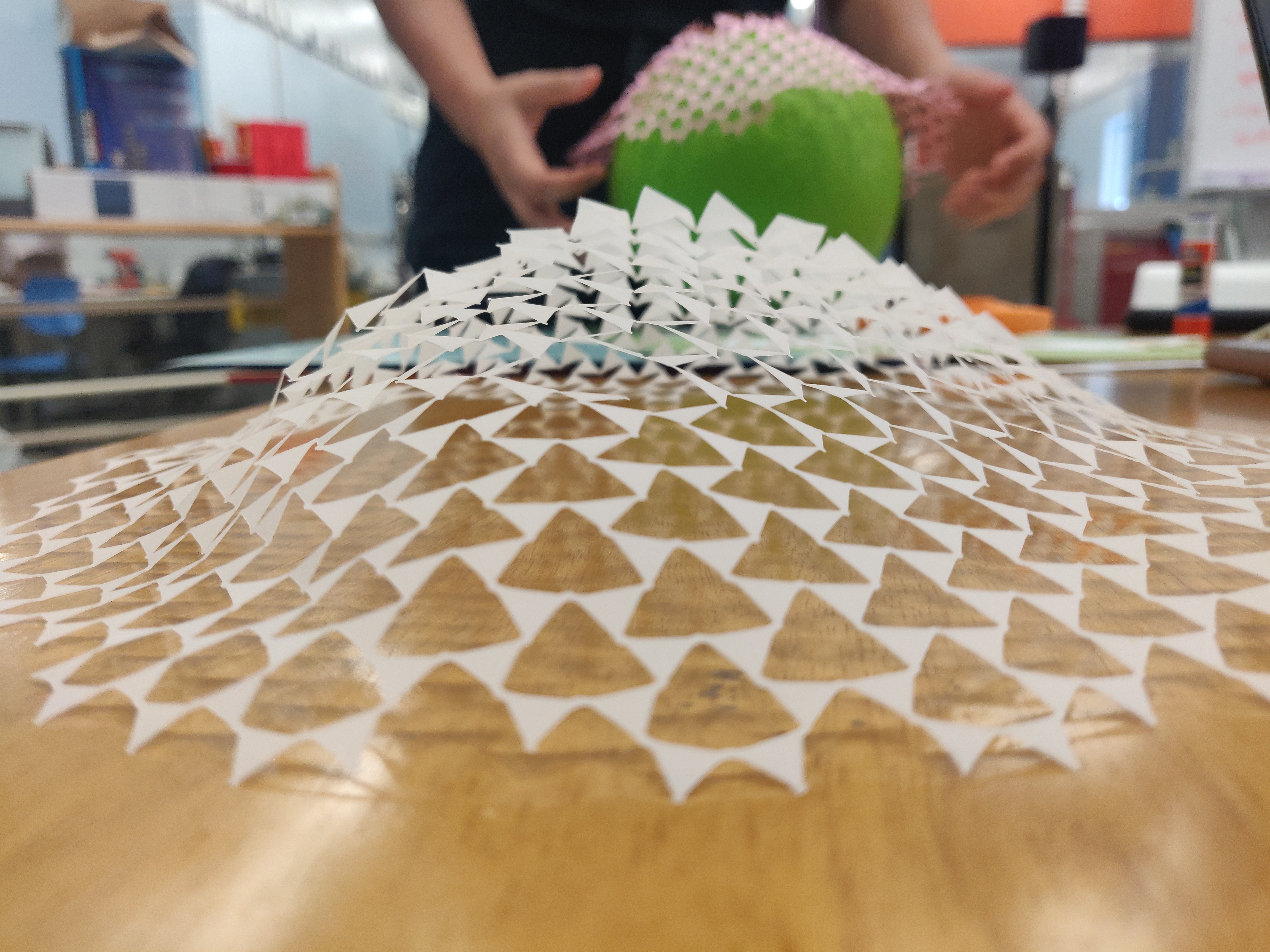
Semi-deployed physical demonstrator
Repository & Getting-Started doc: github.com/d8maldon/Auxetics. Earlier blog posts: LEMUR lab profile. Related lab work: Delsin Carbonell, Andrea Guerrero.